

Born Under a Bitter Pint
Unlike every focus group-born vehicle clogging your commute home, the Ineos Grenadier didn’t begin life in a boardroom. It began in a pub. Specifically and not coincidentally The Grenadier in Belgravia Square, London—a charming brick-front institution a stone’s throw from Buckingham Palace. Here Sir Jim Ratcliffe, billionaire industrialist and lifelong 4×4 enthusiast, and friend/superyacht designer Toby Ecuyer, first sketched the former’s idea of reanimating the classic Land Rover on a five-pound note. A truck beloved on both sides of the Atlantic for its no frills off-road capabilities matched with rugged, unapologetically macho aesthetic. Basically Mr. Blonde—the mustachioed Camel Trophy guy proudly proclaiming “Where a Man Belongs” in ’80s cigarette ads—manifested in four-wheel form. (Fun fact: Sir Ratcliffe has since bought the eponymous pub, unveiled the first Grenadier clay model outside and permanently parks a unit out front. The aforementioned five-pound note also hangs on its walls.)
Here, over a pint of bitter, Ratcliffe voiced a frustration many off-road purists share: the original, old-school Land Rover Defender was gone, and the new ‘L663’ 110 model, however capable, had drifted toward luxury and, perhaps worse in those unforgiving circles, overwrought complexity. So he approached Jaguar Land Rover with a proposal to license the classic Defender shape and co-develop a spiritual successor.
The answer was no. So he built one anyway, and Ineos Automotive was born. That refusal became the marque’s animating force: a quiet but emphatic Because you said I can’t! mentality. Unlike legacy automakers weighed down by decades of committee thinking and overlapping corporate priorities, Ineos Automotive was born without baggage. No 70-year-old brand DNA to protect. No shareholders demanding a softer crossover. Just a single, uncompromised brief: build the world’s best off-roader.

Utility by Design
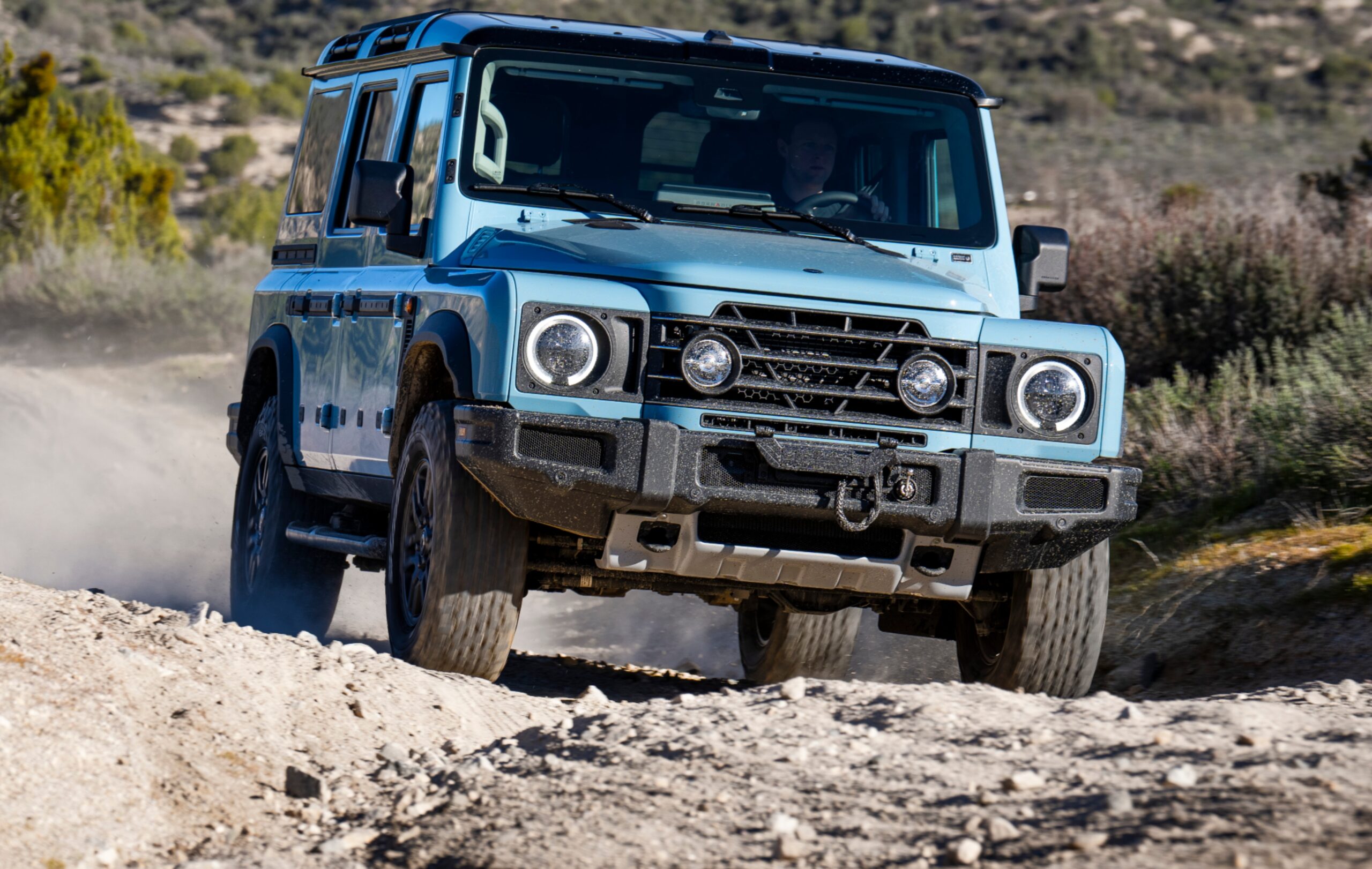
Unsurprising given its homage to the classic Defender, the Grenadier looks exactly like what it is: a tool. Boxy, upright, unapologetically square. Short overhangs. Flat glass. Proper steel bumpers. It doesn’t flirt with coupe rooflines or LED theatrics. Instead the Grenadier prioritizes visibility, interior space, and the ability to mount gear almost anywhere on the shell (thanks to a utility rail running its length, on which aftermarket accessories can be easily bolted). The silhouette is deliberate—not nostalgic cosplay, but truly functional geometry.
Underneath it all sits a full ladder-frame chassis developed by Magna Steyr, the same powerhouse behind Merc’s G-Wagen, and engineered for boulder-crawling punishment. Fittingly, production happens at a former Mercedes facility in Hambach on the French-German border. Purchased and retooled for the job by Ineos Automotive, they retained almost all of its 5,000-person workforce. Component sourcing reads like an off-roading engineer’s dream: BMW B58 inline-six engine; ZF auto transmission; Bosch steering box designed for semi-trucks; Bilstein shocks, Brembo brakes and Recaro seats; Carraro axles used in heavy equipment like John Deere and Caterpillar; BFGoodrich KO2 rubber. Nothing trendy or experimental, just proven hardware.

Inside, the Grenadier doubles down on its philosophy of mechanical simplicity. You won’t find any massaging or ventilated thrones here—intentionally. Ventilated seats would compromise the ability to hose out the interior, and that capability was non-negotiable by Sir Ratcliffe from the white sheet. In fact the entire lower cabin is engineered for wash-down durability, complete with drainage provisions. Those switches on the utilitarian, almost aviation-like central dashboard don’t wiggle due to faulty construction, they do so because they’re gasket-sealed for water resistance.
The actual key is physical—like you have to stick it in the ignition and twist. Imagine that! Windows auto-down with a single click, but not up — two less ECUs to fail. There’s a manual parking brake. Hydraulic-assisted rack and pinion steering won’t self-center, a trait preferred in technical off-roading but definitely takes a bit getting used to. No drive-by-wire minimalism, but total mechanical intentionality. Still, we imagine it’s probably caused more than one fender bender at your local Erewhon.
Everything about the system feels designed by people who’ve actually been stuck somewhere remote, fists shaking at the sky.

Threading the Performance Needle
To put that all in perspective: a fully optioned Grand Cherokee carries over 100 ECUs, a new Defender 110 over 150 ECUs and actuators. The Grenadier exists on the opposite end of that complexity spectrum with a mere 36 ECUs, firmly subscribed to the “one less thing to break” school of thought. There’s no gauge cluster over the steering wheel, instead the speedometer lives in the center console. Controls are glove-friendly. Even the infotainment is stripped back, a large rotary dial managing core functions. The Ineos Grenadier feels analog because it is—easily the most analog vehicle we’ve road tested since racing a 1955 Mercedes-Benz 300SL on the Mille Miglia.
Driving the Grenadier through the urban gauntlet of Los Angeles reveals a quite unique beast. In the current market, the Ineos occupies a fascinating middle ground. Against say, a Jeep Wrangler—arguably a 10/10 in pure trail capability—the Grenadier lands at about a 9.2, while offering significantly better highway composure. Against the new Defender 110, which leans toward refined on-road dynamics, the Grenadier offers superior mechanical ruggedness while sacrificing a touch of civility, both in refinement (luxurious materials, power assistance (seat adjustments, sunroof, etc.) and overall driving comfort. It’s the Goldilocks option that splits the difference between the two words of top-level off-roading. Not the most comfortable, nor the most extreme. Where exactly your desires sit in that spectrum is your call.

Off-Road Beast Mode
Perhaps the purest expression of the Grenadier’s mission is its dedicated Off-Road Mode—activated from a ceiling-mounted switch panel that feels more cargo aircraft than luxury SUV. To engage, you hold the button until it flashes, then confirm. It must be pressed twice because it disables a slew of federally mandated systems. Once activated the Grenadier shifts personality: electronic stability control relaxes, parking sensors and front cameras shut off, annoying seatbelt chimes silence, wheel slip loosens for traction. You can even drive with the doors open (exceed the 50-mph speed threshold and all systems automatically re-engage).
Low range can be used up to about 40 mph. Engaging it requires being in neutral. The center differential lock can be activated anytime, high or low, even while moving. Triple locking differentials (center, front, rear) are available, but front and rear locks require low range and Off-Road Mode. Meanwhile, the infotainment’s off-road screen provides five live data views: pitch and roll (up to a dizzying, and class-leading, 45 degrees), steering angle, G forces, altitude, compass heading, and tire pressures. There’s also a Pathfinder breadcrumb feature that logs your route so you can retrace it later. Everything about the system feels designed by people who’ve actually been stuck somewhere remote, fists shaking at the sky.
Sadly we did not have time to seriously test out the Grenadier’s lofty off-road chops, so we’ll have to believe the engineering. We can say the dirt roads we did traverse were consumed with military levels of determination.

The Detour: Arcane Works Cranks Up the Luxury
Then there’s our new Detour model, developed by Ineos’ in-house bespoke division, Arcane Works. Importantly, this is an aesthetics-focused edition: no mechanical upgrades, no performance changes, this limited edition peacock is about materiality and presence. Inside, unique Detour specs include black leather trim combos not found in standard offerings, exclusive light gray leather with contrast stitching in unique patterns, silver-and-black “Arcane Works” detailing on control dials, and even a cashmere headliner—wildly unexpected in a hose-out SUV. Externally, the Detour receives a distinct headlight grille design and subtle model-specific badging. You can easily pop out safari windows—the only sunroof option on any Ineos—and stand through them like Mr. Blonde himself, reinforcing the truck’s expedition-ready identity. Like Ineos’ Belstaff edition, made in collaboration with the British outerwear legend, think of the Detour as a tailored field jacket instead of a waxed canvas one—same toughness, just with a suave finish.
Globally, the Grenadier is sold in over 50 countries, with roughly 35 dealerships in the U.S. (more coming online soon), plus Canada and Mexico locations. Pricing begins around $71,000, which may surprise buyers expecting luxury trimmings at that number. But that’s the point: with Ineos you’re paying for steel, engineering, and durability —not seat ventilation modules. And that’s the basement sticker—the Detour limited edition model we drove tips the scales with a MSRP of $156,185. But the Ineos Grenadier exists because someone refused to accept that rugged simplicity was obsolete; we certainly hope it’s not. It’s stubborn in the best way, mechanical where others are digital. And in a segment increasingly defined by lifestyle marketing, that kind of clarity feels refreshingly rebellious. As a fitting tribute to the classic Land Rover, this British marque aims to add road going savvy to the Defender’s legendary 4×4 muscle.
Follow the adventures of Deputy Editor Nicolas Stecher on Instagram at @nickstecher and @boozeoftheday.