
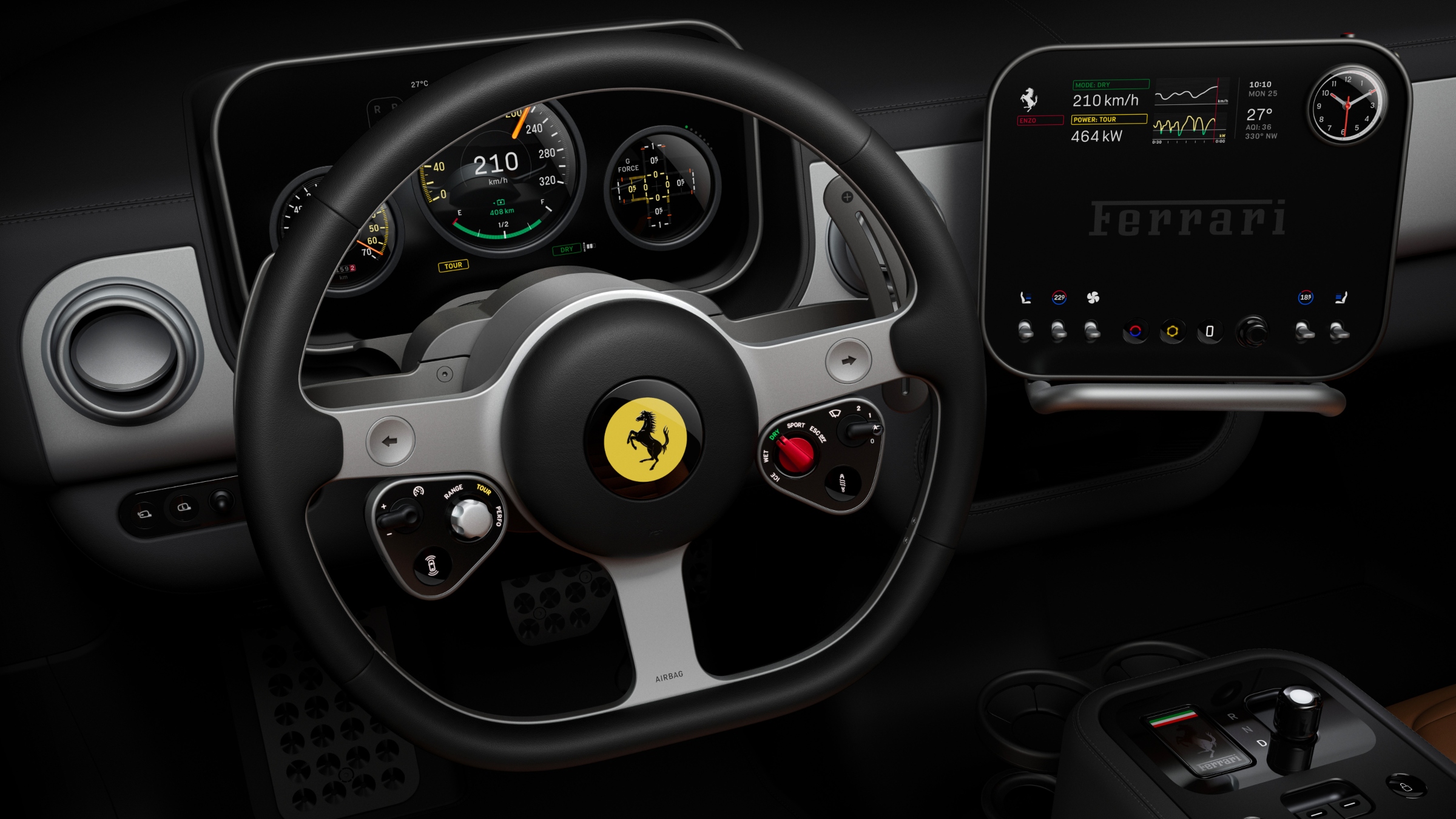

If these interior images are any indicator, the arrival of Ferrari’s first all-electric vehicle will have been well worth the wait. The upcoming model, which is expected to be fully unveiled in May, is named “Luce.” Preliminary specs suggest 1,000 horsepower from a quad-motor setup, a sub-2.5-second 0–62 mph time, and 330 miles of estimated range. Impressive, but as is so often the case with these immaculately conceived Prancing Horses, design is the driving force behind the project.
As such, the Ferrari Styling Centre, led by Flavio Manzoni, collaborated intimately with LoveFrom on the interior. The San Francisco-based creative collective is led by Sir Jony Ive and Marc Newson, who almost single-handedly shaped the personal technology trends of the past 20 years with their work on the Apple iPod, iMac, and iPhone.
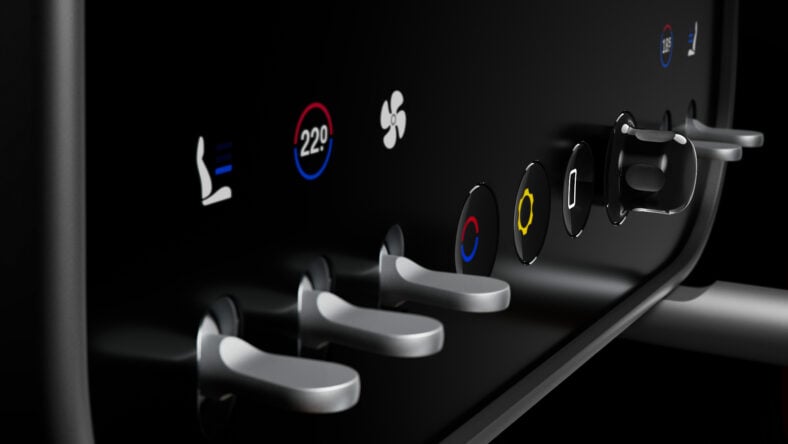
Ferrari says that the “cabin is conceived as a single, clean volume, with forms simplified and rationalized in the service of driving, creating an environment that feels calm, focused, and spacious. Hardware and software were developed together, so the physical architecture and the interface behavior feel harmonious. Essential elements such as the binnacle, control panel and central console are self-contained and clearly organized around inputs (controls) and outputs (displays).”
Most of the metal seen in these images is entirely recycled and anodized aluminum–chosen for durability and integrity—that’s machined from solid billets using 3- or 5-axis Computer Numerical Control (CNC) technology to create an “ultra-thin, hexagonal cell microstructure on the surface.” All glass is precision-milled Corning Gorilla Glass—an evolution of lightweight, scratch-resistant smartphone glass that’s specifically engineered for automotive applications.

Given Newsom and Ive’s involvement, one might expect to see the most radical deployment of button-less touchscreens seen in a vehicle. But instead of entering a pissing match with Mercedes and Cadillac and their 50-inch-plus pillar-to-pillar glass displays, Ferrari and LoveFrom kept things simple by paring down the interface to its essential functions, which are actuated through a combination of Gorilla Glass screen and mechanical controls.
“When everything is flat, you stop absorbing the information,” Ive told Car and Driver of the interface’s design. “We used touch on the phone to solve a problem [of not enough real estate to hold all the needed buttons for the desired applications]. In a car, that’s just the wrong technology.”
The Luce’s steering wheel features an exposed aluminum three-spoke design, a modern interpretation of the wooden Nardi wheels used in Ferraris during the 1950s and 1960s. Constructed from 100 percent recycled aluminum, the wheel is 400 grams lighter than current production versions. Ferrari officials said the wheel’s controls are modeled after Formula One cockpits, utilizing two analog modules. Each button underwent more than 20 evaluation tests with professional drivers to achieve specific acoustic and mechanical feedback.
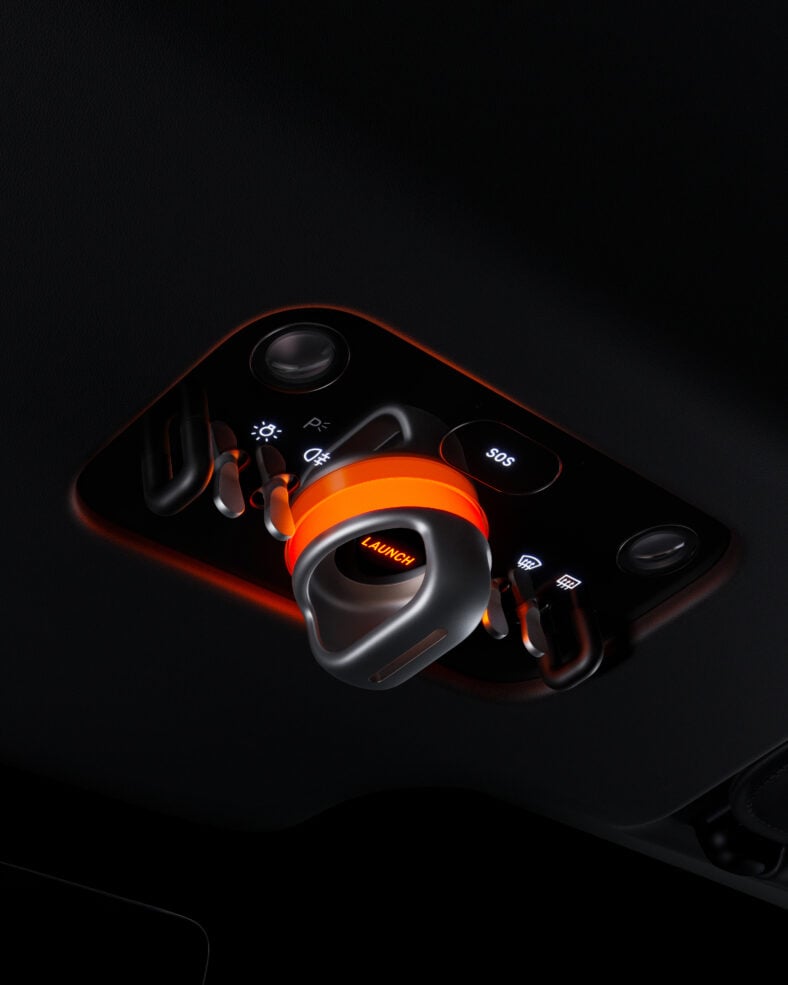
The car’s key is crafted from Gorilla Glass and features an integrated E Ink display—the first time the low-power electronic paper technology most famously featured in the Amazon Kindle has been used in an automotive key. When the key is docked in the center console, it triggers a “choreographed” startup: the key shifts color from yellow to black as the dashboard and instrument binnacle illuminate. Developed with Samsung, the binnacle uses two overlapping OLED panels. Three precision cutouts in the top layer allow information from the second screen to show through, creating a 3D visual effect.
For the first time in a Ferrari range car, the instrument cluster is mounted directly to the steering column, moving in sync with the wheel’s adjustment. A central control panel features a ball-and-socket joint that allows the screen to tilt toward the driver or passenger. It houses a “multigraph”—a micro-engineered dial with three independent motors that can switch between a clock, chronograph, compass, and launch control.
Like the key, the car’s shifter is laser-etched from Gorilla Glass. To achieve uniform graphics, Ferrari used lasers to create holes half the width of a human hair to deposit ink into the glass.

The design team said the interface, which uses a new custom typeface, was inspired by vintage Veglia and Jaeger gauges, which supplied the instruments for many of Ferrari’s 1950s/1960s-era dashboards. The goal was to reduce “cognitive load,” allowing drivers to read digital data with the same ease as a mechanical watch.
This will likely be the last official look at the Luce before it’s fully unveiled at a May event in Italy, where Ferrari will likely also provide finalized pricing (rumored to be nearly $600,000) and specific production timelines.