
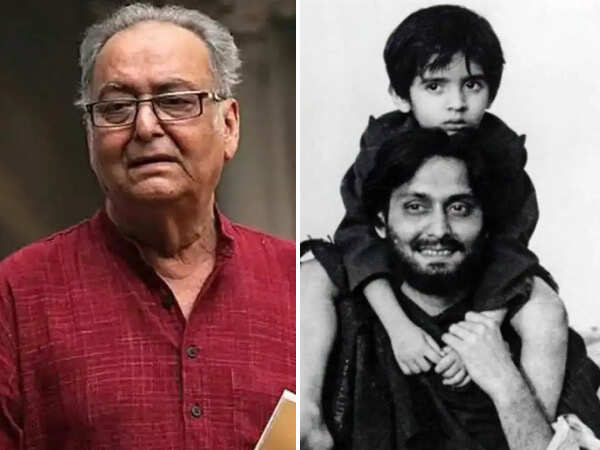
Soumitra Chatterjee is widely regarded as one of the most legendary actors in Indian cinema, especially in Bengal, where his influence shaped generations artistes. Known for his classical good looks, acting prowess and effortless charm, he was often described as one of the most handsome actors of his time.
However, as a child, he suffered from an inferiority complex and feared that he wasn’t good-looking enough. During his last conversation with Filmfare, the actor shared, “As a child, I suffered from an inferiority complex. But not to the extent of being called pathological. In my family, everyone was good-looking. I feared I wasn’t good-looking enough. They’d wonder where this dark child came from. It would upset me, but acting gave me the scope to hide myself. My father (a lawyer and an amateur actor) encouraged us to act, recite poems…That gave me a push to go in this direction.
He continued, “I was admired in my class. I played football, hockey, cricket… I forged friendships in school. I loved being with people. But one habit that actually saved me was reading books. At home, I was given books to stop me from playing pranks. Today, I can’t travel without a book. From being a high court advocate to a government servant, my father had transferable jobs. When we came from Howrah to Kolkata, the city opened windows. I was exposed to Kolkata theatre.”
He made his film debut in 1959 with Apur Sansar, directed by Satyajit Ray, playing the adult Apu. The role instantly established him as a major talent and marked the beginning of one of the most important actor-director collaborations in Indian film history.
Talking about the maestro, Chatterjee continued, “Satyajit Ray discovered me. He had an intelligent judgement of human character. He could sense my capabilities. Actually, most of my directors gave me freedom to do what I deemed fit. And the greatest of them all, Satyajit Ray, too gave me a lot of freedom. He was unafraid that I’d misuse the freedom. He could trust me just as I trusted him. If I did something wrong he’d point it out, ‘Hey don’t do that. Do this’. He also knew how much he could get from me. That’s why he cast me in more than a dozen films (including Apur Sansar, Abhijan, Charulata, Aranyer Din Ratri, Sonar Kella as Feluda and Joi Baba Felunath and Ghare Baire). My association with Ray is a rare thing. It’s a landmark in world cinema. There have been collaborations of beautiful magnitude like that between filmmaker Akira Kurosawa and actor Toshiro Mifune. But such a long association where I became almost Ray’s mouthpiece or his face on the screen is rare. Regarding work, we hardly differed. Maybe in private life, we may have differed on a particular thing. We had many things in common like our interest in art, our legacy of Tagore, our attitude towards life. That kept us together.”
Chatterjee passed away on November 15, 2020 after suffering from Covid-19. His legacy is one that will be remembered beyond the bounds of regional cinema.
Read the full interview here: Exclusive Interview: In conversation with Bengal Thespian Soumitra Chatterjee