
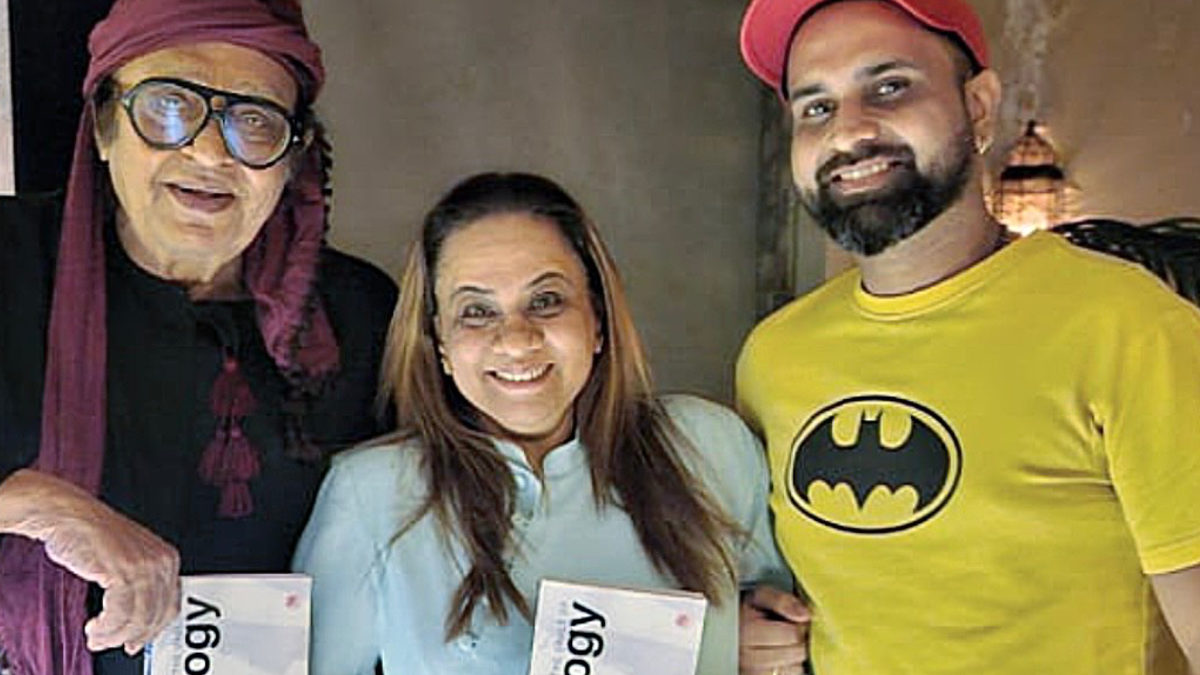
In an industry often associated with glamour, red carpets and box-office figures, producer Chitra Vakil Sharma believes cinema’s true power lies far beyond surface appeal. Extending her support to director-writer Anmol Mahajan’s book The Vault of Filmology, Sharma says the book challenges conventional perceptions of filmmaking, presenting it not as an isolated creative act but as a natural extension of lived experience and accumulated knowledge.
“Cinema is not just about visuals or fame,” Chitra explains. “It is a disciplined process where knowledge, observation, ethics and human experience come together to create meaning.” Drawing from her own years in the film industry, she stresses that no film exists in a vacuum. Every story, she believes, is influenced by the world around it — shaped by history, psychology, politics, science, management and even the smallest moments of everyday life.
“What we study in classrooms often feels theoretical at the time,” she says. “But its true relevance reveals itself much later, often on a film set. That’s where theory finally turns into reality.”
This belief is precisely why The Vault of Filmology resonates so strongly with her. Rather than functioning as a conventional filmmaking handbook, Chitra describes the book as a reflection of life itself. In a time when professional paths are increasingly fluid and uncertain, she feels the book asks a deeply relevant question: what if filmmaking isn’t a break from one’s existing profession, but a continuation of it?
According to Sharma, the book speaks directly to professionals who feel creatively restricted yet hesitate to abandon years of education and work experience. Instead of urging readers to discard their past, Filmology reframes cinema as a space that absorbs and builds upon prior knowledge. “It reassures people who are standing at a crossroads,” she says. “It tells them that nothing they’ve learned is ever wasted.”
One of the aspects Chitra values most is the book’s grounded honesty. She notes that it does not romanticise stardom or promise instant success. “It doesn’t sell dreams,” she says candidly. “It talks about process, structure, discipline and responsibility. That kind of honesty is rare, and it’s refreshing.”
As portrayed in the book, filmmaking emerges as an organised and accountable practice where creativity is guided by clarity rather than chaos. For individuals considering a career shift, Sharma believes The Vault of Filmology offers a realistic and practical framework rather than illusion-driven motivation. She attributes this grounded perspective to Anmol Mahajan’s own professional journey.
With a background in advertising and years of experience directing and producing ad films, Mahajan understands the importance of precision, deadlines and immediate yet authentic audience engagement. “He knows how the real world works,” Sharma points out. “That sharpness is evident throughout the book.”
She adds that Mahajan’s writing reflects a careful balance between creative instinct and structured thinking — an approach rooted in real-world decision-making rather than abstract theory. “He understands that cinema is influenced by people, society, markets and time,” she says. “That confidence comes from working across both creative and strategic spaces.”
In an era where young professionals are often encouraged to follow passion without a clear roadmap, Chitra believes The Vault of Filmology offers something far more valuable. “It offers clarity,” she says. “It presents filmmaking as a language where multiple disciplines can interact.”
She emphasises that the book’s relevance extends well beyond aspiring filmmakers. Teachers, engineers, managers, students and lifelong learners can all find meaning in its ideas. “Cinema isn’t separate from life,” Chitra concludes. “It is life examined, organised and returned to us through collective effort.”
For anyone navigating curiosity, transition or professional uncertainty, Sharma feels the book makes no promises of shortcuts. “It doesn’t offer escape,” she says. “It offers understanding. And in today’s unpredictable world, that understanding may be the most powerful tool of all.”